
Category Archives: Uncategorized

Why I Cry: A Reflection on Race and Racism

This post is a response to an exchange that happened at a conference in the US. It is raw and emotional. It is about race, and racism. It is about power, and it draws on academic responses to power and race.  It is personal, but I share it because I think we all have a lot to learn…your responses are welcome. But please be gentle.

To the Black man who asked, “Is it possible to trust a white Christian?”

While I was on a raised platform facing a room full of people,

My white face on display.

I would not cry in front of you, even though tears of shame and shock immediately pricked at my eyes.

I would not cry because I am a white woman, and I know that white women’s tears suck all the oxygen from the room – they take all the attention away from the question that no one wants to hear. If I cry, I make my pain central. If I cry, I detract from your pain, your community’s pain, which looms large. And I know that you are asking this question right now, in this moment, in this time and place, because you have been burned by white people. Your community has been burned by white people. And white people are burning down your country. It is a valid question.

But it is the first time in my life that I have had such a question directed at me – Oh I know it wasn’t personal, but it feels so personal. Because I know about complicity. I know that although I am an advocate for justice, I am just a broken human being who tries to be open and fair and graceful. I fail all the time. Just as my ancestors failed. I know that as a Christian, I willingly take responsibility for what the past offers the future…I take responsibility for the failures of my ancestors. And my own failures. But let me tell you why I want to cry. I cry because I am paying attention to the pain your community has endured. I cry because I feel helpless, even though I know I am immeasurably powerful. I cry because I am ashamed of the colour of my skin, even though I was born in it and had no say in the matter. I cry because the world is falling apart, and it seems we are lost in a tidal wave of white Christian nationalism, and no amount of shouting on my part will change that. I cry because you are confronting me, not personally of course. But how can I take it any other way when I cannot look you in the eye and tell you I am trustworthy. Because I am afraid, too. Because I feel powerless, too. Because I feel accused. Because I too am subject to impulses and false perceptions and a skewed view of history.

I will bear the weight of your question. Because I am curious about what will happen if I take your question seriously and allow it to open my heart. I am anxious to do the right thing, even though I know that any move I make will be wrong. I am hopeful that there is a way forward, a future in which we can sit down and you can decide for yourself whether I am worthy of trust. Or compassion.

If we cannot sit down together and try to answer this question, there is no hope for anything at all. I will bear the weight of your question in my body. And I will cry. Even as I try to hide my own tears so that they do not interrupt yours. I do not defend the tears of white women. I only hope that one day we will cry together, that our shared tears of lament will move the sleeping God to alertness. I am sorry for all the pain, all the centuries, all the wrong. Your question, however, will not silence me. I will keep speaking because I have something to prove. Even if my tears are an abomination – a betrayal of black experience – I am going to keep fighting for justice. Even though I get it wrong. Even though my words falter, and I can only see through my white eyes. If anything, your question inspires me to do better, to put away my tears and get to work.

Just so you know, every page of my work is tearstained, washed in deep sorrow and deep hope. Please may the powers of empire not be allowed to do what they wish – they will take those of us who follow Jesus and tear us apart from each other – they will divide and conquer, and we are left with animosity instead of engagement. I will bear the weight of your question because I want to be in relationship with you. I want truth to win. And I want a different future for my children.

So thank you, whether you are friend or foe, I am grateful.
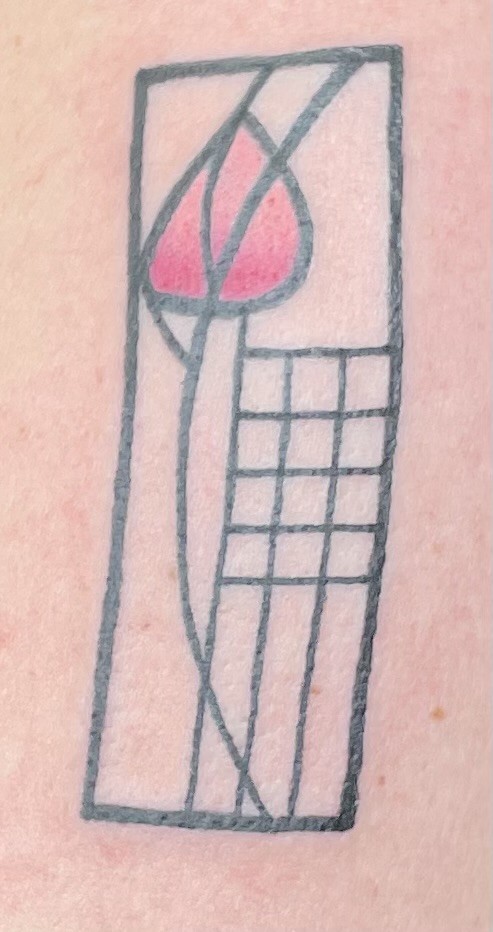
Theological Reflections on a Tattoo

I’m tired of following the rules. That is one reason why I chose to get myself a tattoo as a 49th birthday gift. It reminds me that my body belongs to me, and I get to choose how I inhabit this body. It is a risk to permanently emblazon a symbol on one’s body…but I’m relatively confident that this symbol, and its meaning, will stay relevant. So what does it mean? I ran a photo of the tattoo through AI and this is what google has to say:

“The image shows a tattoo inspired by the designs of Charles Rennie Mackintosh, a Scottish architect and designer associated with the Art Nouveau movement. The tattoo features a stylized rose motif, a signature element in Mackintosh’s work, enclosed within a geometric frame. This design is likely based on Mackintosh’s architectural drawings, furniture designs, or decorative panels, which often incorporate stylized floral and geometric forms. Mackintosh’s work is characterized by its clean lines, subtle curves, and the integration of organic and geometric shapes.”

I love architectural motifs. They are clean and structured. They remind me of the incredible creativity of humankind, and the ways we choose to structure our lives. But it is the combination of architectural and organic motifs that caught my attention with this symbol. It made me think of my favourite quote from the Old Testament scholar Walter Brueggemann, who said:

“The power of God is a wild card amid the social schemes we devise, suggesting that newness can come in unexpected ways…God had a purpose other than our arrangements and an inexplicable capacity to change what cannot be changed”

Human beings devise a lot of schemes and structures. So much of our reality is socially constructed – that is, we as human beings choose how we will function in life, how we will relate to other people and to God. Our theology is also a construction – it is a wild guess about what God has done, is doing, and will do. Sometimes, we are bound by our created structures – we draw thick lines that separate us from each other. We build structures that determine the worth of individuals and groups. We build structures that are impermeable, unchanging, stark. I’m thinking about how we determine social roles and responsibilities – we carefully build binaries and place people in boxes. In the current economic and political climate, we see how our human-made structures fail – they are not flexible or nimble enough to sustain us in dark days.

Enter the power of God – which comes not as a fixed and unchanging structure but as a wild and organic gracefulness. Hence the tattoo. A highly structured, manmade environment (the boxes) is interrupted by a fluid and natural grace (the flower). God does not operate according to our structures but introduces curves and beauty into our forced and permanent creations. As much as we think we have built something important and worthy, we are always interrupted by Grace. The good news is that we do not have to be confined by the rules we have invented. We are always free, in conversation with the Divine, to revise our plans in favour of God’s wild grace.

We are ultimately not bound to human invention, but only to the wildness of the Holy Spirit. So the unbudging, geometric boxes are infiltrated by new life that comes in the form of flowers and imperfections and possibility.  Nature has its own structure, of course, as does God’s movement in the world. But it is not confined to straight lines.

We don’t have to be stuck in the boxes we have created. God invites us into pattern that is more free and more beautiful. In these days of global despair, it is helpful to be reminded that God’s ways are not our ways. After all, Jesus Christ was like a stunning rose that bloomed and broke the structures of human oppression and captivity.

I want to be reminded, every day, in my own body, that God has arrangements other than what I have planned and devised. What seems permanent and unchangeable can be altered, transformed. Thus, there is hope.

At a Loss for Words

I have been silent, lately. Not so long ago I had so much to say that I almost couldn’t keep up. Then my breath was stolen by the proximity of death. I have been on a journey to the end of my mother’s life. And while on that journey I felt my lips were sealed, and I had nothing at all to say. What a strange thing for a writer – to lose her voice when there is so much to be said. It was, however, my turn to be silent. My turn to listen. I wonder if God closed my mouth so that I could hear better.

My mom’s journey was a textbook end-of-life story. Her body was old and tired, and she stopped eating, hydrated poorly, and couldn’t get out of bed. The doctors at the hospital did what they could, and in the end, it was her decision to enter hospice care. We took her home, and for three weeks we cared for her, celebrated her and listened to her – we bore witness to a life of both joy and suffering. It was hard and wondrous work to keep her comfortable, with a steady parade of caregivers to support us. After the initial shock of entering hospice care and recognizing that she would soon die, my mom began to talk. And talk. And talk. For days on end she told all the old stories, retold all the favourite recipes. She planned her funeral and said all the things she needed to say. She talked until she could talk no more, and then she cried for a while, and then she went to sleep. It was a peaceful and graceful ending.

The silence in the house was deafening when the talking stopped. Not being a particularly demonstrative family, our cries were silent and personal – there was no weeping and wailing although maybe that would have done us good. Instead, there was only the quiet of a house from which a spirit has fled a ravaged body.  I managed to speak a few words at her Celebration of Life– heartfelt and appropriate – but only a drop in the bucket.

I still haven’t cried properly. There have been tears here and there but not the fierce release of real weeping. I’m writing now, but I’m not sure whether the words will flow or drip like a broken faucet. It occurs to me that maybe my time for listening is not over. I need to listen to my own body and retrieve the rhythms that were lost in the messiness of palliative caregiving. I need to listen to the voices of my community which have supported me and loved me through every up and down. I need to listen to the tones of Holy Saturday which urge me to stay and mourn awhile, that resurrection will come, in time, but not today.

 My speech doesn’t have the power to raise the dead. But Jesus does. My grief work so far seems to be about paying attention to the patterns of grace that are superimposed on my trauma. About listening to the promises whispered by the Holy Spirit – that the story is not yet over. In our world resurrection happens slowly – a tantalizing and miraculous unfolding of life that is just barely visible in the darkest hour. This halting speech won’t last forever, there will be words again and songs again but not today.

A Safer Space

I write because it is how I process and integrate information and emotions. Sometimes, what I write feels urgent and I want to share with others. Facebook is a dangerous place because it is so vulnerable to misinterpretation, trolls, and unhelpful feedback. If I am to continue to share my thoughts about ministry and the church, I need a safer space. Which is why I’ve decided to blog instead. You’ll see an invitation on Facebook when I have a new post, and you’ll find me here at sarahtravis.ca

I cannot promise an entirely safe space because it is still a public blog. However, here, I can do a better job moderating the discussion. Only genuine and thoughtful responses are permitted here. I will not tolerate responses that are racist, sexist, homophobic etc. I invite you into a conversation about a better future that is rooted in our hope in Jesus Christ. I will talk a lot about preaching – but frequently conversations about preaching are relevant for those who are not preachers! We all participate in proclaiming hope through our words and actions. So welcome, and thank you for trusting me.